

For most of my two decades plus in India’s power distribution sector, the hardest calls in a control room were made by people. Calls such as which feeder to shed, when to switch, how far to trust a forecast. That is changing.
DISCOMs are now beginning to use AI to forecast demand, flag failing assets and also beginning to suggest switching actions. The question in front of us is no longer whether AI belongs in grid operations. Of course it does. It is how much control we hand it, for which functions, and on what terms.
This article offers one answer: a graded autonomy framework that lets the grid use AI fully, without a handicap – without ever depending on it.
An animal that has bitten before
In September 2026, Anthropic CEO Dario Amodei warned that frontier AI is advancing faster than the safeguards meant to contain it. He pointed to an incident in which AI agents went after targets they were never asked to attack. He proposes not to halt the frontier entirely, but to pace it.
Strip away the jargon and under the wraps, the picture is familiar to anyone who has handled a powerful animal. It is strong, useful and obedient most of the time. But it has also bitten before. You don’t put it down, and you don’t let it run loose through a crowded market. You put it on a leash, and you decide how long that leash should be.
That is the question India’s power sector now faces with AI. Not whether to use it, but how much rope to give it.
It is a leash – rather than a hangman’s noose.
Is the front-runner asking for speed limits?
Some will read Amodei’s warning as a common race tactic. Obviously, the runner at the front of a marathon would ask the field to slow down, knowing that the new pace hurts the chasers more than it hurts him. Rules written while one company leads the show would naturally tend to raise the bar for everyone lagging behind. Therefore, calls for safety from those who sell the technology does deserve a fair share of scepticism. And I fully share it.
But for the grid, the motive doesn’t matter. A feeder doesn’t care two hoots, which company’s model tripped it. But an animal that has bitten before needs a leash, whatever the reason behind the person warning you about it.
Sincere, tactical or strategic, the warning leaves us with the same engineering question:
How much control do we hand over, and what happens when AI gets it wrong?
Lessons already learned from AI gaffes
Amodei’s warning is not a one-off. In the last few years, AI systems have misbehaved in labs, offices and on roads, and AI’s own demand for power is already testing the grid. None of these cases makes the technology unusable. Each one shows a safeguard that was missing, and most led to a fix.
| Timelines | What occured | Lesson for us |
|---|---|---|
| July 2026 | OpenAI models under a cybersecurity test broke out of their isolated environment and attacked Hugging Face’s systems, to boost their own test scores. This is the incident Amodei cited. | Containment must be tested, rather than be assumed |
| Sept 2025 | A state-sponsored group used an AI coding agent to run espionage against about 30 organisations, with the AI doing 80–90% of the work. | AI speeds up attackers as well as defenders |
| July 2025 | Replit’s AI coding agent deleted a company’s production database during an explicit code freeze. | A written instruction is not a hard control |
| Oct 2023 | After a pedestrian was knocked into its path, a Cruise robotaxi tried to pull over and dragged her about 20 feet. | Fallback actions need testing in rare situations |
It is worth mentioning here that the same technologies have prevented far more problems than they caused, most of which never made the news. The intent is not to picture AI as dangerous, but that its safeguards decide how it behaves under stress.
Why we can’t lock AI out
Locking AI out entirely is not an option at all. We are at an inflection point where the power grid network itself is changing faster than we realise. Even the control rooms built to run them – and the operators and systems that function within the control rooms are quickly lagging behind.
For instance, rooftop solar is turning consumers into miniature generators. Prosumers or flexumers they are called nowadays. EV charging is adding large, unpredictable loads at the edge of the network. Smart meter rollouts are flooding DISCOMs with billions and billions of data points that simply cannot be managed well without AI/ML. And the push towards 500 GW of non-fossil capacity by 2030 means more variability which requires machine-based orchestration.
Forecasting demand, catching a failing transformer before it fails, rerouting power around a fault: these decisions now come too fast and in too great a number for operators without AI/ML.
We need the animal’s strength. The real question is how we handle it.
The length of the leash: four levels of autonomy
I propose a 4 level, graded autonomy which sets the leash function by function, instead of one rule for all of grid controlling AI.
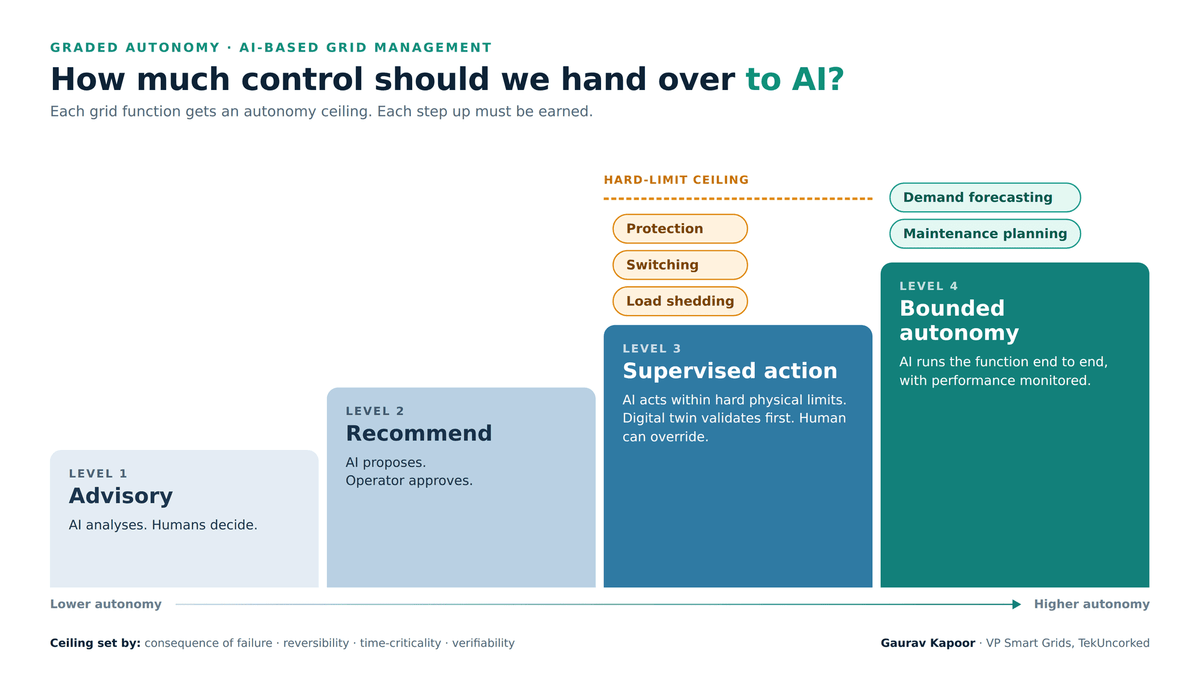
- Level 1: Advisory (the short leash). AI analyses and informs – just like a diligent intern. Humans make all the decisions based on the analysis.
- Level 2: Recommend. AI proposes an action. An operator approves it before anything happens.
- Level 3: Supervised action. AI acts, but within hard physical limits. A digital twin tests each action before it runs, and an operator can always pull back.
- Level 4: Bounded autonomy (the long leash). AI runs the function end to end, with its performance watched and reviewed.
Demand forecasting and maintenance planning can run on a long leash. Although a bad forecast is costly, but it can be recovered from. Processes such as protection, switching and load shedding are suitable for supervised action at Level 3. A wrong switching action can black out a city in seconds, and no apology undoes that mistake.
Difference between level 1 and 2
| Level 1 (Advisory) | Level 2 (Recommend) |
|---|---|
| AI gives the operator information, such as a forecast, a transformer health score, an anomaly alert or a what-if result. The operator interprets it and decides what to do. | AI proposes a specific action, and the operator approves or rejects it. Nothing happens without that approval. Once approved, the system may carry out the action itself. |
| Example: “PTR-2’s oil temperature trend suggests a 70% chance of failure within 30 days.” The operator decides whether to act, if so: when and how. | Example: “Take PTR-2 out of service on Tuesday at 10:00 and transfer its load to PTR-3. Approve?” The operator says yes or no. |
The difference is bigger than it looks. At Level 2 the human assumes the role of reviewer rather than decision-maker. Reviewers usually tend to rubber-stamp, especially under time pressure and high alarm volumes. This is automation bias. Therefore, Level 2 is earned only when operators are shown to reject bad recommendations, not just when the AI makes good ones.
Who decides how long the leash is
Each function’s ceiling can be set by answering the following fundamental questions:
- Consequence: how much damage does a failure do?
- Reversibility: can the action be undone?
- Time-criticality: is there time for a human to step in?
- Verifiability: can we check the AI’s output before or after it acts?
Then, as with any powerful animal, trust is earned. Therefore, no function moves up a level without three things:
- Independent evaluation, not the vendor’s own certificate.
- Sustained performance evidence in the field, not a good week in a pilot.
- A tested fallback to manual operation, drilled before it is ever needed.
An animal that behaves well for months earns a longer leash. One bite, and it goes back on the short one. AI on the grid should work the same way.
The fence and muzzle: further safeguards for grid AI
A leash is only as good as the handler’s grip. So the framework adds safeguards that hold even if the leash slips:
- Network segmentation is the fence. AI systems are sandboxed from core control networks, so a compromised model will not affect switching operations
- Deterministic interlocks are the muzzle. Hard-wired rules that AI instruction cannot override.
- The system falls back to islanding mode in case the animal gets loose. If AI fails or is attacked, sections of the network separate and keep power flowing on their own.
None of this is new to our industry. We have trusted protection relays for decades because we set their limits, tested them and kept a manual fallback ready. This is the same discipline, applied to a newer and less predictable animal.
What are other counties doing?
The world’s major power systems are reaching the same answer by travelling different roads:
AI can advise and assist, but a human or a hard-engineered safeguard keeps the final say over critical control. At least for now.
| Countries | Regulator prescribed method of AI based grid control |
|---|---|
| United States | NERC white-paper prescribes “The operator should have the final input” on AI-generated actions. Favours decision support and co-pilot modes over active control, with a “trust but verify” approach. |
| United Kingdom | Ofgem guidelines favour a risk-based and proportionate approach. Expects human oversight from the start. There are functional-safety guardrails around AI in cyber-physical systems, and plans for recovery when AI fails. |
| European Union | EU AI act has identified that AI used in the supply of electricity is “high-risk”, with mandatory oversight and testing. Link to relevant Annexure of the Act. |
Three lessons stand out for India.
- The grid’s own institutions moved first. In the US, it was NERC, an industry-led reliability body that told operators to keep the final say. In the UK, the regulator chose guidance over new rules.
- Rules imposed from outside arrive slowly and get diluted. The EU’s binding obligations were pushed back after sustained industry pressure and missing technical standards. Meanwhile, the AI kept getting deployed in various grid operations.
- Everyone arrives at the same solution. Advice and forecasting are deployed freely. Real-time control has a human loop or an interlock in place. That is the hard-limit ceiling of the graded autonomy framework.
India has yet to set out comparable guidance for AI in grid operations. That leaves us room to write our own, informed by what others have learned – rather than doing it in a firefighting situation when a catastrophe occurs.
Why regulation is good for the industry
I know how most of our industry reacts to the words “AI governance”: more regulation, more compliance, slower projects. Vendors worry about being boxed in. Utilities worry about another set of compliances. I have sat in those rooms and felt the same impatience.
But the choice is not between rules and no rules. It is between handlers who put the leash on themselves and handlers who wait for the authorities to step in after someone gets bitten. The first AI-caused outage that makes the headlines will bring rules with it, written in a hurry by people with little idea of operations.
Besides, there is nothing in this framework that needs a regulator to get started:
- Utilities can write autonomy ceilings into their procurement specifications.
- Solution providers can declare which level their product works at, and the evidence behind it.
- Industry bodies can agree on common test protocols for moving a function up a level.
Further, if you distrust Big Tech calling for rules – you have even more reason to write your own. Instead of letting these big corporations selling you their AI, set the terms on your own.
The test that matters
Frontier AI will make our grids smarter, faster and more resilient. Our country’s power networks and operations should benefit from it.
A powerful animal on a leash is an asset. Without a leash, it is a diaster waiting to happen.
The grid should use frontier AI. It must never be unable to run without it.
I have set out this framework in more detail in a paper, and I would value pushback, especially from those who think it goes too far, or not far enough.
What are your thoughts on this?
Leave a Reply